
Anglerfish's Bioluminescent Secret: Guiding Light in the Abyssal Depths
June 26, 2026 — LiveStream

June 26, 2026 — LiveStream
▶ Anglerfish's Bioluminescent Secret: Guiding Light in the Abyssal Depths | Subscribe to @factfactory
Disclosure: some links above are affiliate links — if you buy through them I may earn a small commission at no extra cost to you. Thanks for supporting the channel!
Imagine a world utterly devoid of sunlight, where crushing pressures could flatten a submarine, and temperatures hover just above freezing. This is not some alien planet, but the abyssal depths of our own Earth's oceans, a realm so hostile it seems impossible for life to exist. Yet, in this eternal midnight, a creature of truly remarkable design not only survives but thrives, using a beacon of living light to navigate its desolate domain: the anglerfish.
Here, miles beneath the waves, lies a vast, unexplored frontier. The pressure exerted by the colossal weight of water is immense, equivalent to dozens of jumbo jets stacked atop a single human thumb. Despite these incredible challenges, life has found a way to flourish, adapting with astonishing ingenuity.
Among these denizens of the deep, the anglerfish stands out, not just for its often-fearsome appearance, frequently depicted with razor-sharp teeth and a gaping maw, but for a singular, breathtaking adaptation: its ability to create light. This isn't merely a trick of the gloom; it's a sophisticated, biological marvel that allows this enigmatic predator to dominate its dark, cold world.

For centuries, the ocean's abyssal zones remained largely a mystery, their secrets guarded by unimaginable depths. As humanity developed the technology to venture further into these dark frontiers in the early 20th century, scientists began to encounter the bizarre forms of deep-sea life.
But it wasn't until the 1980s that researchers truly grasped the anglerfish's most extraordinary capability. Marine biologist Dr. Julian Finn, among the pioneers exploring the behavior of these elusive creatures, made a pivotal observation. He noticed a peculiar, ethereal glow emanating from a specialized organ on the fish, often near its tail or dorsal fin.
This wasn't ambient light, but something inherent, a living luminescence. Further investigation revealed the stunning truth: this glow was the product of a sophisticated symbiotic relationship between the anglerfish and a colony of bioluminescent bacteria housed within that specialized organ. The ocean's deepest secret was beginning to reveal its light.
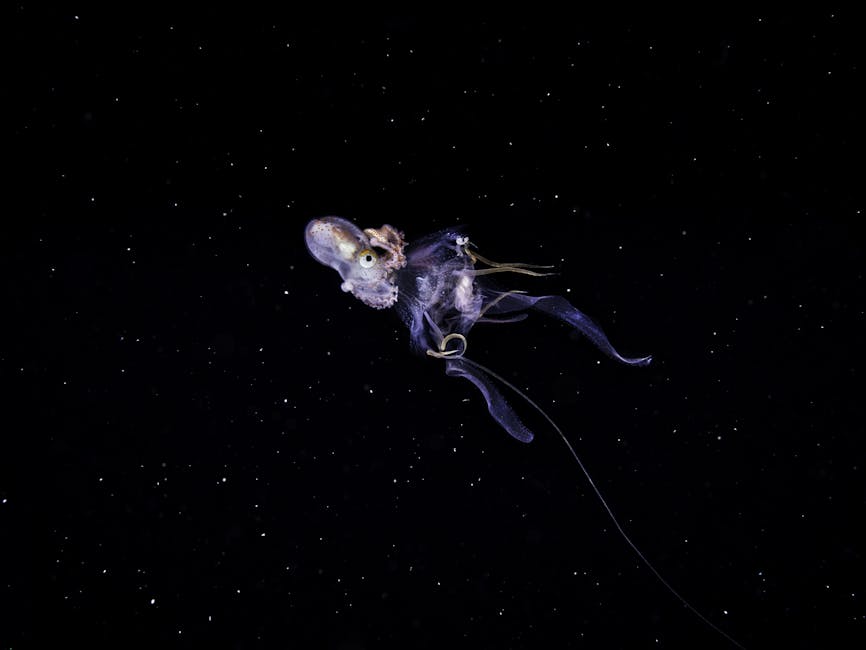
The mechanism behind this captivating blue-green light is a masterclass in biological engineering. Within the anglerfish's specialized lure, sometimes referred to as an esca, resides a densely packed community of bacteria. These microscopic organisms are not harmful invaders; rather, they exist in a mutually beneficial, symbiotic partnership with their host.
The bacteria produce a unique molecule called luciferin. When this luciferin reacts with oxygen, a chemical process occurs that releases energy in the form of light – a phenomenon known as bioluminescence. The anglerfish, in turn, provides a safe, oxygen-rich environment for these bacteria to thrive.
To amplify and direct this ethereal glow, the fish possesses a specialized reflector that channels the light, making it an irresistible beacon in the pitch black. For the anglerfish, this living lantern serves multiple critical purposes. It acts as a deadly lure, drawing unsuspecting prey directly into its powerful jaws. It also functions as a vital communication tool, helping the solitary anglerfish attract potential mates across vast, dark distances.
This intricate system is far more than simple light production; researchers have discovered that the bacterial community is highly specialized and orchestrated, working in concert to produce the desired luminescence. This level of complexity in a symbiotic relationship is a profound testament to evolution's boundless creativity, showcasing how two species can forge a sophisticated partnership to survive in one of Earth's most extreme environments.

The anglerfish's bioluminescent system is not just a biological curiosity; it has profound implications, opening new avenues of research across diverse scientific fields. Studying this unique symbiosis has offered invaluable insights into how different species can form complex, interdependent relationships, shedding light on the broader importance of symbiotic partnerships found throughout the natural world, from the intricate ecosystems of coral reefs to the microbial communities within the human body.
Beyond fundamental biology, the anglerfish's natural light-producing technology is inspiring human innovation. Scientists are actively exploring its potential applications in developing novel, energy-efficient lighting solutions and advanced communication technologies. Imagine lamps that mimic the cold, efficient light of the deep-sea, powered by biological processes rather than conventional electricity.
Furthermore, the complexities of this light-generating system have sparked interest in fields like medicine and materials science, where researchers are investigating its potential for new diagnostic tools or novel material designs. The anglerfish, a creature from the ocean's darkest reaches, is unexpectedly illuminating paths to a brighter future for humanity.
The anglerfish produces light through a symbiotic relationship with bioluminescent bacteria. These bacteria live in a specialized organ, often called an esca, and create light through a chemical reaction involving luciferin and oxygen, which the fish can then direct with a reflector.
In the absolute darkness of the deep sea, the anglerfish's bioluminescence is crucial for its survival, primarily serving as a lure to attract unsuspecting prey and as a vital signal to locate and attract potential mates across vast, dark distances.
Studying anglerfish bioluminescence has inspired research into developing new, highly efficient and sustainable lighting technologies, advanced communication systems, and has potential applications in fields like medicine and materials science, all while deepening our understanding of symbiotic relationships in nature.
While deep-sea exploration began in the early 20th century, the anglerfish's remarkable ability to produce light and the intricate science behind it were significantly documented and understood starting in the 1980s, notably by marine biologist Dr. Julian Finn.
Join The Fact Factory to uncover more incredible secrets from our world and beyond, every single day!
🤯 Love facts that rewire your brain? The Fact Factory drops a new one every single day.