
Deep-Sea Anglerfish: The Glowing Predator of the Abyss
June 29, 2026 — ny_wk

June 29, 2026 — ny_wk
▶ Deep-Sea Anglerfish: The Glowing Predator of the Abyss | Subscribe to @factfactory
Disclosure: some links above are affiliate links — if you buy through them I may earn a small commission at no extra cost to you. Thanks for supporting the channel!
The deep-sea anglerfish is a fist-sized predator that dangles a glowing lure from its forehead, swallows prey larger than itself, and fuses its tiny mate permanently to its own body. It lives more than a kilometer beneath the waves in a realm of crushing pressure, near-freezing cold, and total darkness, and almost everything about it sounds like science fiction even though every word is true.
Picture a face that is mostly mouth, lined with needle teeth that curve inward like the bars of a one-way cage. Above that mouth, a slender stalk arches forward and ends in a softly burning blue-green light. In the blackness of the abyssal zone, that single point of light is often the only thing a passing animal will ever see, and following it is the last decision the animal will ever make.
"Anglerfish" is not one species but an entire order, the Lophiiformes, containing more than 300 known species. The truly bizarre deep-sea forms belong to a suborder called the Ceratioidei, the ceratioid anglerfishes, and these are the creatures of nightmare-documentary fame. They haunt the bathyal and abyssal depths, roughly 300 to 4,000 meters down, where sunlight has been extinguished entirely.
Most deep-sea anglerfish are surprisingly small. A famous female of the species Melanocetus johnsonii, the humpback anglerfish, measures only about 12 to 18 centimeters, smaller than a human hand. Their fearsome reputation comes not from size but from design. The body is soft, dark, and globular, built to drift rather than chase, conserving every precious calorie in an environment where a meal might come once a month.
That dark coloration is itself a survival tool. Several deep-sea anglerfish possess ultra-black skin that absorbs more than 99.5 percent of the light striking it, among the blackest natural materials ever measured. This camouflage keeps the predator invisible even when its own glowing lure casts light into the water nearby.
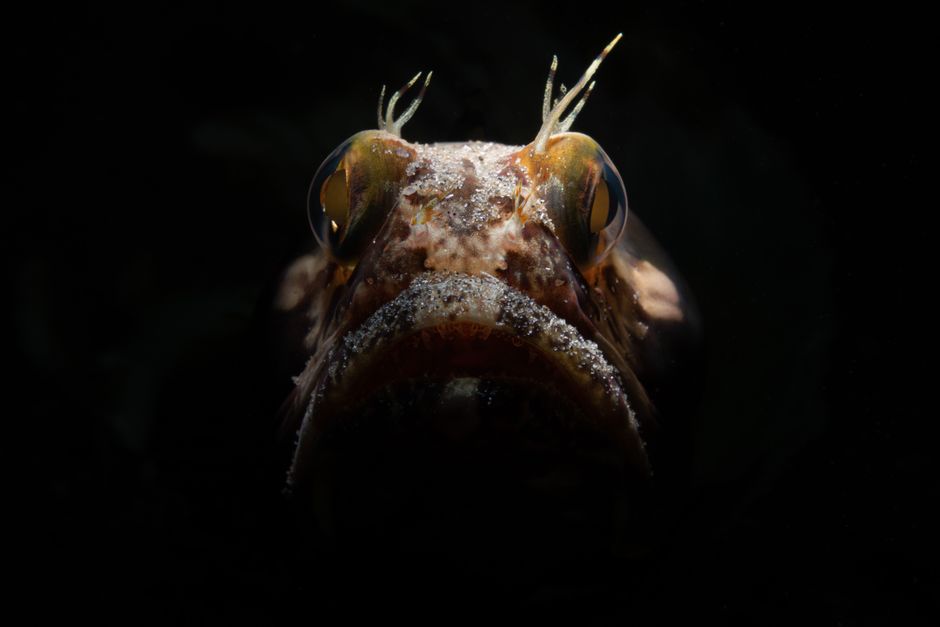
The most iconic feature of the deep-sea anglerfish is the lure that gives the family its name. It is a modified spine from the dorsal fin, evolved into a fishing-rod-like structure called the illicium, tipped with a bulbous lure called the esca. The fish can twitch, wave, and reposition this lure to mimic a small swimming animal.
The glow is genuine bioluminescence, but here is the remarkable twist: the anglerfish does not make the light itself. The esca is hollow and packed with colonies of luminous bacteria. These symbiotic microbes produce the blue-green light through a chemical reaction, and in exchange the fish gives them a safe, nutrient-rich home. Strip the bacteria away and the lure goes dark.
Scientists are still untangling how the host and its bacteria find each other in the immensity of the deep ocean, since the glowing partners appear to be acquired from seawater rather than inherited. The light is used primarily to attract curious prey within striking range, and some researchers also suspect it plays a role in helping mates locate each other in the dark. When a victim drifts close, the anglerfish strikes.
That strike is one of the fastest and most extreme feeding actions in the sea. The anglerfish can open its enormous jaws in milliseconds, creating a sudden vacuum that sucks water and prey straight into its mouth. Its stomach is wildly expandable, and its inward-curving teeth prevent escape, so an anglerfish can swallow prey up to twice its own length. In the food-starved deep, the rule is simple: eat anything that fits, because the next chance may be a long time coming.

If the lure is the anglerfish's signature, its reproduction is its true masterpiece of strangeness. In many ceratioid species the female is dozens of times larger than the male, sometimes hundreds of thousands of times heavier. The male is a tiny, almost helpless creature equipped with little more than huge eyes and powerful smell organs, tools dedicated entirely to one mission: find a female before he starves.
When he finds her, often by tracking a species-specific pheromone through the dark, he bites onto her body and holds on. Then something extraordinary happens. In the most extreme species, his skin fuses with hers. Their blood vessels join, his eyes and internal organs degenerate, and he becomes a permanent appendage drawing nourishment directly from her bloodstream. This is true sexual parasitism, and the anglerfish is the only known vertebrate that does it.
A single female can carry several attached males at once, becoming a self-contained breeding unit ready to release fertilized eggs whenever conditions allow. The evolutionary logic is brutal but elegant. In a habitat so vast and so empty that two anglerfish might never cross paths twice, the safest strategy is to never let go once you have found a partner.
Recent research has revealed an even deeper mystery here. This permanent fusion should be impossible, because any animal's immune system normally rejects foreign tissue, the same problem that makes human organ transplants so difficult. Studies have found that anglerfish have evolved a drastically weakened adaptive immune system, abandoning key defenses so that two bodies can merge into one. It is a biological trade-off no other backboned animal has dared to make.
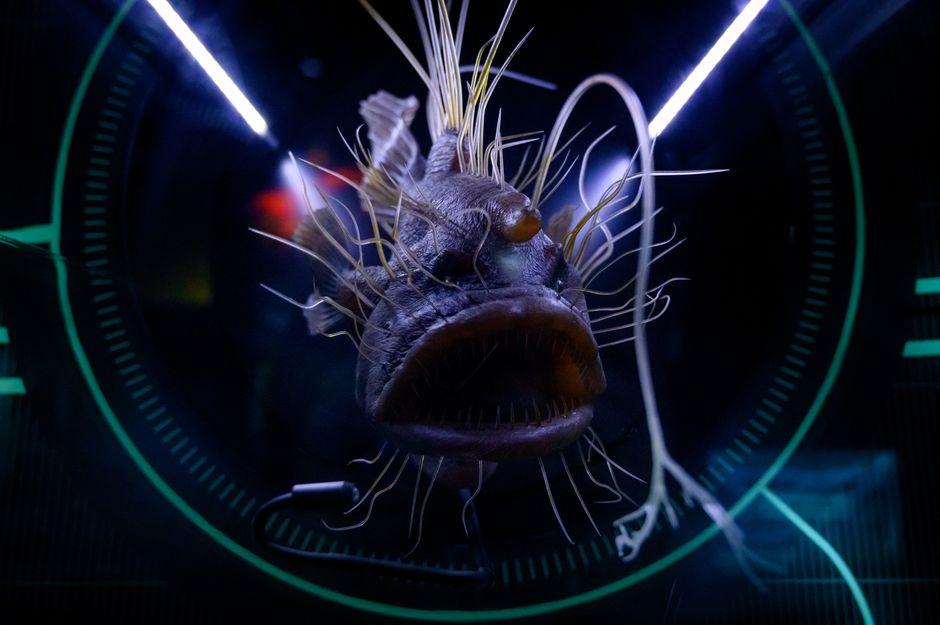
To appreciate the anglerfish, you have to appreciate where it lives. At a depth of 2,000 meters the pressure is roughly 200 times that at the surface, enough to collapse a submarine and crush most surface animals instantly. The water hovers just a few degrees above freezing, and beyond the reach of sunlight there are no plants, so the entire ecosystem runs on scraps drifting down from above, a slow snowfall of dead organisms known as marine snow.
In this world, the anglerfish thrives because it asks for so little. Its soft body needs no heavy skeleton to resist the pressure, since the pressure inside and outside its tissues is balanced. Its sluggish metabolism lets it wait, motionless, for opportunity. Its glowing lure turns the very darkness that defines the abyss into a hunting advantage. Every grotesque feature is, in fact, a finely tuned answer to an impossibly hostile question.
Our understanding of these animals has grown slowly because they are so hard to reach. The deep-sea anglerfishes were scientifically described over the eighteenth and nineteenth centuries from rare specimens hauled up in nets, and the modern picture of their biology owes a great deal to the decades-long work of ichthyologist Theodore Pietsch, whose research clarified their classification, their lures, and the astonishing details of their parasitic mating. As recently as 2018, a deep-sea expedition captured the first-ever video of an attached pair alive in their natural habitat, a moment that scientists had waited generations to witness.
No. The light comes from bioluminescent bacteria living inside the lure. The fish provides shelter and nutrients, and the bacteria provide the blue-green glow. It is a symbiotic relationship, not a light organ the fish powers on its own.
Yes, in many deep-sea species. The much smaller male bites onto the female and, in the most extreme cases, his tissue and blood vessels permanently merge with hers. He then lives as an attached source of sperm, fed by her body for the rest of his life.
Most are small. Females of well-known species like the humpback anglerfish are only about 12 to 18 centimeters long, while the attached males can be just a centimeter or two. Their menacing look, not their size, earns them their reputation.
Deep-sea ceratioid anglerfish typically inhabit depths of roughly 300 to 4,000 meters, in the bathyal and abyssal zones where sunlight never reaches and pressures would crush most surface life.
The deep ocean is the largest habitat on Earth, and it is still mostly unexplored. If a hand-sized fish with a bacterial lantern and a fused-on mate is hiding down there, imagine what we have not found yet. Follow The Fact Factory and keep discovering the strange, true wonders of our planet.
🤯 Love facts that rewire your brain? The Fact Factory drops a new one every single day.