
The Unseen Choreography: How Millions of Animals Move as One Without a Leader
September 26, 2026 — ny_wk

▶ The Unseen Choreography: How Millions of Animals Move as One Without a Leader | Subscribe to @factfactory
Disclosure: some links above are affiliate links — if you buy through them I may earn a small commission at no extra cost to you. Thanks for supporting the channel!
Imagine millions of individual creatures, each with its own simple agenda, yet moving as one breathtaking, fluid entity. No signals from above, no grandmaster plan – just raw, decentralized coordination. This isn't science fiction; it’s the astonishing reality of emergent animal behavior, where complex, synchronized movements in swarms and flocks arise from incredibly simple, local interactions. It’s a jaw-dropping a sign of nature's genius, challenging everything we think we know about leadership and organization.
Here at @factfactory57, I'm constantly chasing those mind-bending truths that reshape our understanding of the world. And honestly, few things are as profoundly cool as observing how entire populations of starlings, fish, or ants operate with a kind of collective intelligence that makes our most sophisticated systems look clunky. We're going to pull back the curtain on this unseen choreography, exploring the fundamental rules that allow these animal collectives to achieve feats of synchronized movement that are both beautiful and incredibly effective.
The Great Illusion: How Simple Rules Create Complex Patterns
My fascination with emergent animal behavior started with a single video of a starling murmuration years ago. I remember thinking, "How is that even possible?" The sheer scale, the perfect synchronization, the way the flock flowed like liquid – it felt orchestrated by an invisible conductor. But here’s the kicker, the surprising truth: there is no conductor. There’s no leader at the front dictating moves, no single bird sending out commands. That’s the core of emergence: sophisticated, large-scale patterns arise purely from the interactions of individual agents following very basic, localized rules.
Think about it. If you were tasked with designing a system where thousands of birds needed to move together smoothly, what would you do? Most of us would instinctively design a hierarchy, a leader, a command center. Nature, however, went with something far more elegant and robust. Each individual creature in a swarm, flock, or school isn't thinking about the whole. It's only paying attention to its immediate neighbors. It's asking questions like, "Are you too close? Are you too far? Which way are you going?" And from these hyper-local, almost selfish calculations, a global masterpiece of coordination springs forth.
This decentralized approach has profound advantages. It's incredibly resilient. If one individual fails, the whole system doesn’t collapse. It’s also highly adaptable, able to react almost instantly to threats or opportunities because information propagates rapidly through the local network. And here's why it matters: Understanding this principle of simple rules leading to complex outcomes isn't just about admiring birds; it’s a blueprint for understanding everything from the formation of galaxies to the way our own brains process information. It shows us that true intelligence isn't always about a central command, but often about the collective wisdom of many simple parts.

The Sky Dancers: Starling Murmurations and the 7-Neighbor Rule
If you've ever witnessed a starling murmuration, you know it's one of nature's most stunning spectacles. Thousands, sometimes tens of thousands, of birds swirl and undulate across the twilight sky, painting ephemeral shapes that seem to defy physics. For years, scientists puzzled over how they achieved such incredible coordination. Early theories even suggested telepathy! But thanks to breakthroughs in computational modeling and high-speed photography, we now understand the beautiful simplicity behind this complex aerial ballet.
The surprising truth is that a starling, amidst a swirling maelstrom of its peers, only pays attention to a very small number of its nearest neighbors. Studies, particularly by researchers like George Young and Irene Giardina, suggest that each starling interacts with approximately 6 to 7 other starlings at any given moment. Not every bird in the flock, just those directly around it. And what are these interactions? They boil down to three fundamental rules, often simplified as:
Separation: Don't get too close to your neighbors; avoid collisions.Alignment: Try to match the direction and speed of your neighbors.Cohesion: Stay close enough to your neighbors to remain part of the group.
That's it. No leader, no complex trigonometry, no GPS. Just these three guidelines, constantly applied by each bird in relation to its immediate vicinity. When a predator like a peregrine falcon dives into the flock, the birds on the edge react instantly, and that reaction ripples through the entire murmuration like a wave. The flock twists and turns, creating a fluid, unpredictable shape that makes it incredibly difficult for the predator to single out an individual target. This rapid, collective response is a prime example of emergent animal behavior at its most visually striking.
Why it matters: This insight isn't just about appreciating pretty bird formations. It teaches us about efficient information transfer in decentralized networks. The ability to propagate information so rapidly through local interactions – often faster than the speed of an attacking predator – is a masterclass in collective defense. It also gives us clues about how to design more resilient and responsive human systems, from robotics to communication networks, by mimicking nature’s elegant solutions.
Ocean Waves: Fish Schools and the Art of Collective Evasion
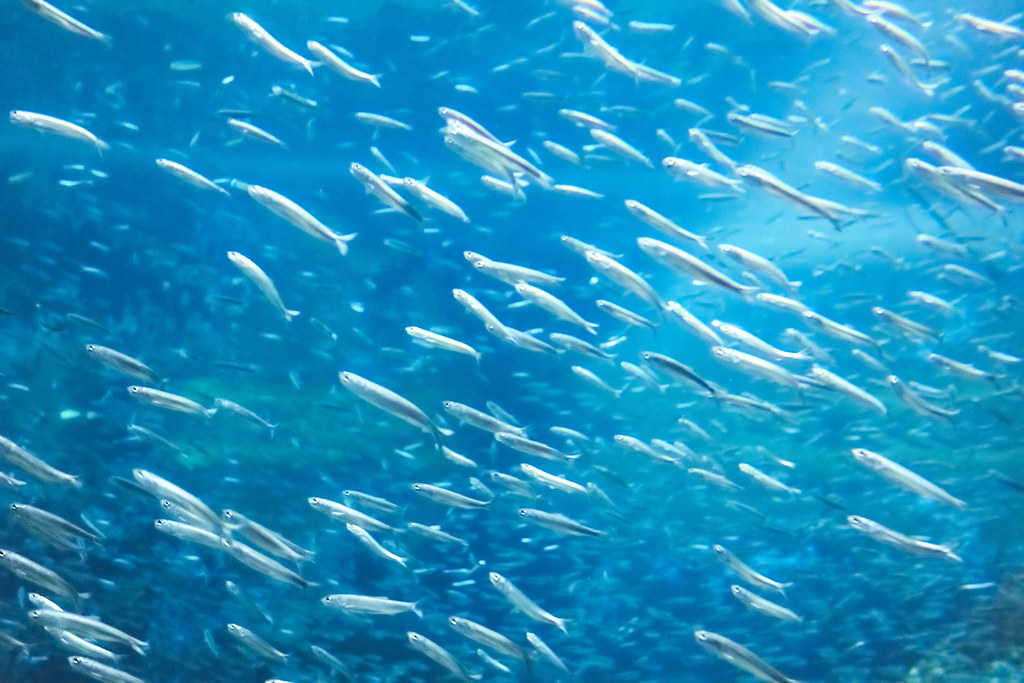
Dive beneath the waves, and you'll find similar wonders of collective movement. Schools of fish, sometimes numbering in the millions, move with a synchronized grace that rivals starling murmurations. From tiny anchovies to massive tuna, these aquatic armies can instantaneously change direction, split into subgroups, and reform, all without a designated leader calling the shots. This is another magnificent display of emergent animal behavior, honed over millennia for survival.
Much like starlings, fish adhere to simple rules: maintain a safe distance from neighbors, align direction, and stay within the group's general proximity. However, the aquatic environment introduces unique sensory challenges and opportunities. Fish rely not only on vision but also on their lateral line system – a specialized sensory organ that detects changes in water pressure and vibrations. This allows them to "feel" the presence and movement of their neighbors, even in murky waters or at night, providing an incredibly sensitive and immediate feedback loop for coordination.
The surprising truth about fish schooling isn't just how they move, but *why* it's so incredibly effective. When faced with a predator, a school offers multiple layers of defense:
- The Dilution Effect: In a large group, the chance of any single individual being caught is dramatically reduced. It's simply harder for a predator to pick out one fish from a million.
- The Confusion Effect: This is arguably the most potent. Imagine a shark trying to target a single fish within a swirling, shimmering mass of thousands. The constant changes in direction, the flashing scales, the sheer overwhelming visual noise makes it incredibly difficult for the predator to fixate on a target. Their attack mechanisms, often designed for single prey, are essentially overloaded.
- The Many Eyes Effect: More eyes (and lateral lines!) mean a higher probability of detecting a predator earlier, allowing for quicker collective evasion.
Why it matters: Fish schooling demonstrates the immense power of collective action in the face of danger. It's a stark reminder that sometimes, the best defense isn't about being the fastest or strongest, but about being part of a well-coordinated, decentralized collective. This principle is vital in fields like cybersecurity, where distributed denial-of-service attacks mirror a predator overwhelming a system, and distributed defense strategies seek to mimic the resilience of a fish school.
Groundbreaking Trails: Ant Colonies and Pheromone Power
Now let's shrink down to the micro-scale, but don't let the size fool you – ant colonies are arguably the most sophisticated practitioners of emergent animal behavior on the planet. Forget leaders; a single ant is, by itself, a relatively simple organism with limited cognitive abilities. It doesn't possess a map of its foraging territory or a blueprint for its intricate nest. Yet, working together, millions of ants construct vast underground cities, establish complex food networks, and defend their territory with astonishing efficiency.
The surprising truth here lies in their communication method: stigmergy. This isn't direct conversation; it's indirect communication through modification of the environment. When an ant finds food, it lays down a chemical trail – a pheromone – on its way back to the nest. Other ants, foraging randomly, will be more likely to follow stronger pheromone trails. As more ants find the food and return, they reinforce that trail with more pheromone. Conversely, if a trail leads to nothing, it slowly evaporates, and fewer ants will follow it.
This simple feedback loop allows the colony to "discover" the shortest, most efficient paths to food sources, adapt to changes in the environment (like a new obstacle), and even find alternative routes without any central command. It's a self-organizing traffic system that optimizes itself in real-time. For instance, if you put an obstacle in an ant's path, initially, ants will try various routes. Those that find the shorter route will lay down more pheromone, quickly reinforcing that new, more efficient path, while the longer, less used trails fade away.
Ant Foraging Algorithm (Simplified)
1.  Ant moves randomly.
2.  If food is found:
    a.  Pick up food.
    b.  Return to nest, laying pheromone trail.
3.  If pheromone trail is encountered:
    a.  Follow trail with a probability proportional to its strength.
    b.  Reinforce trail if carrying food.
4.  Pheromone trails naturally evaporate over time.
Why it matters: Ant colonies are brilliant examples of decentralized problem-solving and collective memory embedded in the environment itself. The concept of stigmergy has inspired algorithms used in computer science for complex optimization problems, like routing networks, scheduling tasks, and even designing more efficient public transportation systems. It shows us that truly intelligent solutions can arise from a multitude of "dumb" agents following very clever, simple rules.
Beyond the Wild: The Human Lessons of Swarm Intelligence
It's easy to look at the mesmerizing dance of starlings or the relentless efficiency of an ant colony and think, "That's cool, but what does it have to do with me?" Well, quite a lot, actually! The principles of emergent animal behavior and swarm intelligence are no longer confined to the natural world. They are increasingly inspiring engineers, computer scientists, and urban planners to design more resilient, adaptive, and efficient human-made systems. This field is known as biomimicry, where we look to nature for solutions to our own complex problems.
The surprising truth is that we're actively using these ancient strategies to solve our most challenging modern problems. Here are just a few examples:
- Robotics: Instead of building one giant, expensive, and easily-broken robot, researchers are developing swarms of small, inexpensive robots that can accomplish complex tasks collectively. Imagine a fleet of tiny robots exploring a collapsed building, searching for survivors, or mapping an unknown planet. If one robot fails, the mission continues.
- Optimization Algorithms: "Ant Colony Optimization" (ACO) algorithms, directly inspired by ant foraging behavior, are used to solve complex routing problems (like finding the shortest delivery routes for parcel services), manage telecommunications networks, and even design circuit boards.
- Traffic Management: Think about how a city's traffic could flow better. Instead of a central control system trying to predict and manage every light, imagine vehicles communicating locally, like individual ants, adjusting their speed and route based on immediate conditions to optimize overall flow.
- Logistics and Supply Chains: Companies are exploring how to manage warehouses and supply chains more efficiently by applying swarm intelligence principles, allowing individual components (e.g., autonomous forklifts, delivery drones) to coordinate their actions dynamically rather than relying on a rigid, centralized schedule.
Why it matters: Our world is becoming increasingly complex and interconnected. Traditional top-down, centralized control systems often struggle to cope with dynamic changes, unexpected failures, or overwhelming amounts of data. By studying emergent animal behavior, we're learning to build systems that are inherently more flexible, fault-tolerant, and capable of self-organization. It's a powerful shift in perspective, moving from trying to control every individual piece to designing environments and rules that allow collective intelligence to flourish naturally.
The Universal Principle: Emergence Everywhere
While we've focused on the mesmerizing movements of animals, it's worth taking a step back and realizing that emergent animal behavior is just one stunning facet of a much broader, universal principle: emergence itself. Complex patterns, structures, and behaviors arise from simple interactions at lower levels of organization all around us. It's a fundamental concept that stretches from the microscopic to the cosmic.
The surprising truth is that once you understand emergence, you start seeing it everywhere. Consider these other fascinating examples:
- Bacterial Colonies: Even single-celled organisms, when aggregated, can form intricate patterns, develop collective resistance to antibiotics, and coordinate nutrient foraging through chemical signaling.
- Slime Molds: These fascinating organisms, often looking like amorphous blobs, are actually collections of individual cells that can come together to form a mobile "slug" when food is scarce, moving as a single entity to find better conditions. They even solve mazes by finding the most efficient path to food!
- Our Own Brains: The incredible complexity of thought, consciousness, and emotion doesn't reside in any single neuron. Instead, it emerges from the quadrillions of simple electrical and chemical interactions between billions of neurons.
- Weather Systems: Hurricanes and thunderstorms are complex, self-organizing systems that emerge from the interaction of countless individual air molecules, water droplets, and temperature gradients following basic physical laws.
Why it matters: Recognizing emergence as a universal principle gives us a powerful new lens through which to view the world. It helps us appreciate that many of the most incredible phenomena, from the intricate beauty of a snowflake to the vast structure of a galaxy, aren't necessarily designed by a grand architect. Instead, they often arise organically from the bottom up, through the repeated application of simple rules and local interactions. It encourages us to look for the underlying simplicity that gives rise to astounding complexity, offering deeper insights into biology, physics, computer science, and even human societies.
Key Takeaways
- Emergent animal behavior describes how complex, organized patterns in groups arise from simple, local interactions of individuals, not from a leader.
- Starling murmurations are created by each bird only responding to its 6-7 nearest neighbors, following basic rules of separation, alignment, and cohesion.
- Fish schools use similar rules, augmented by their lateral line system, to create dazzling evasive maneuvers like the confusion and dilution effects against predators.
- Ant colonies rely on stigmergy – indirect communication through pheromone trails – to efficiently find food and build complex structures without centralized control.
- The principles of swarm intelligence are being applied in human endeavors like robotics, optimization algorithms, and traffic management, ushering in more resilient and adaptable systems.
Frequently Asked Questions
What is emergent behavior in animals?
Emergent behavior in animals is the phenomenon where complex, organized patterns and collective intelligence arise in a group (like a flock, swarm, or school) purely from the simple, local interactions between individual animals, without any central command, leader, or pre-set plan. Each animal follows basic rules in relation to its immediate neighbors, leading to sophisticated large-scale behaviors.
How do starlings fly in murmurations without a leader?
Starlings fly in murmurations by following three simple rules in relation to their closest 6-7 neighbors: avoid collisions (separation), match the direction and speed of neighbors (alignment), and stay near the group (cohesion). These local interactions rapidly propagate information through the flock, allowing it to move and change shape with breathtaking speed and coordination as a single, fluid entity.
What is the role of pheromones in ant colony organization?
Pheromones play a crucial role in ant colony organization through a process called stigmergy. Individual ants lay down chemical pheromone trails when they find food. Other ants are attracted to and follow these trails, reinforcing successful paths. Trails that don't lead to food eventually evaporate. This decentralized system allows the colony to efficiently discover, evaluate, and optimize foraging routes without any central command, constantly adapting to environmental changes.
Can humans apply principles of swarm intelligence?
Absolutely! Humans are increasingly applying principles of swarm intelligence, inspired by emergent animal behavior, to solve complex problems. This includes developing swarms of small robots for exploration and rescue, designing "Ant Colony Optimization" algorithms for logistical and routing challenges, improving traffic flow, and creating more adaptive and resilient communication networks and supply chain management systems.
The natural world is full of these mind-bending phenomena, showcasing intelligence and organization in ways we're only just beginning to fully appreciate. Want to keep exploring the incredible truths behind our world? Follow @factfactory57 for more deep dives and astonishing facts!
Related reading
- The Great Pyramids' Secret: How Ancient Egyptians Moved Millions of Tons Without Modern Tech
- The Universe's Lone Wanderers: How Rogue Planets Survive the Void Without a Star
- The Universe in Slow Motion: How Some Animals Experience Time Entirely Differently Than You
- The Ocean's Hidden Wires: How Sharks and Other Animals 'See' the Electric World
- The Liver's Unseen Superpower: How Your Body's Detox Engine Can Grow Itself Back
- The Ghost in Your Genes: How Your Environment Rewrites Your DNA Without Changing It